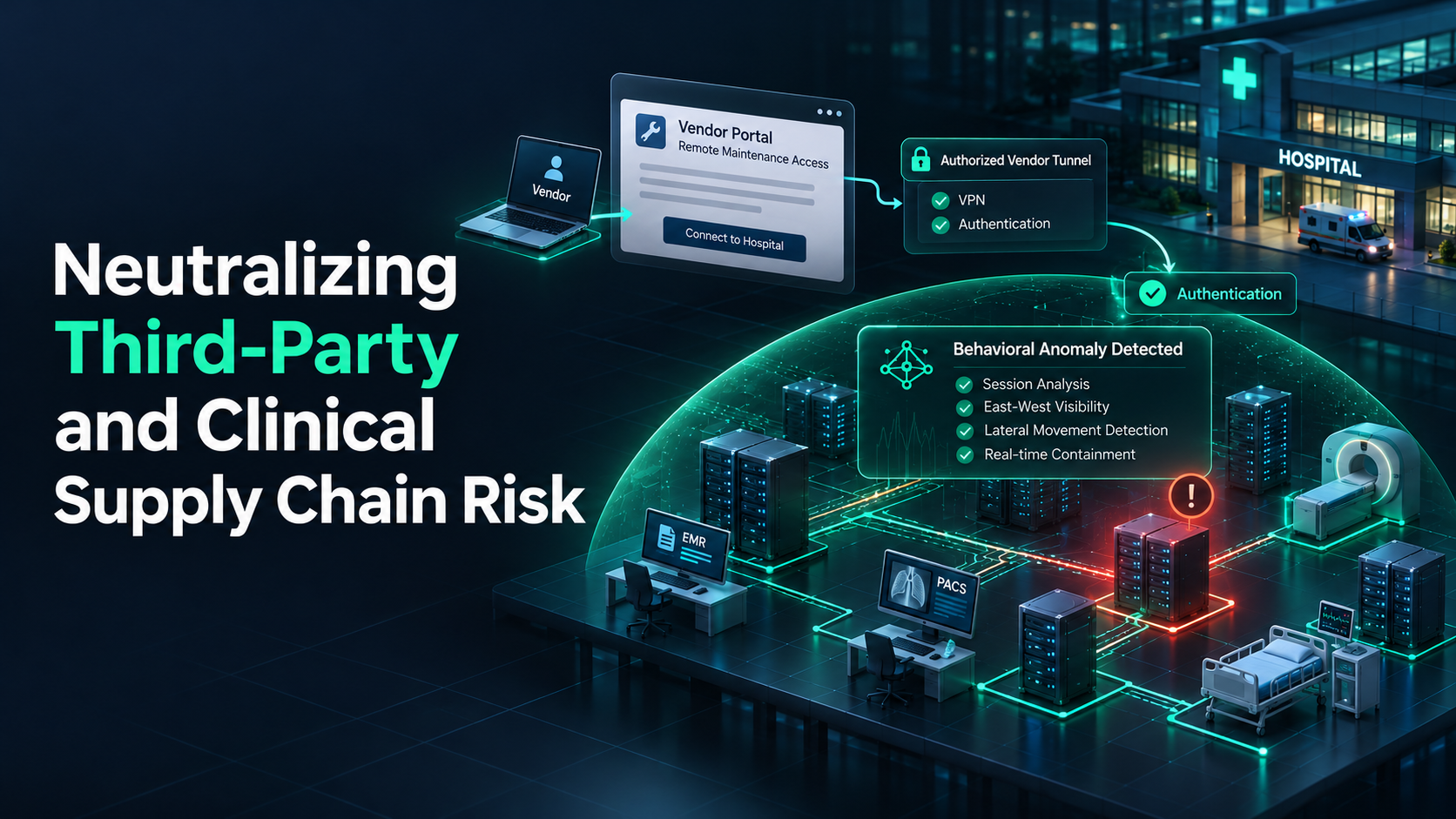
Healthcare delivery systems run on interconnected dependencies. Clinical diagnostic tools, remote radiology reading stations, outsourced billing services, and HVAC controls connect directly to internal hospital subnets. These business associates and medical vendors require remote maintenance tunnels and site-to-site VPNs to perform their work.
When an external supplier suffers a breach, their legitimate remote channels become direct ingress points.
Attackers exploit this relationship. They do not attack the hospital’s hardened perimeter firewalls directly. Instead, they compromise a trusted downstream vendor and ride established tunnels straight into internal networks.
The Vendor Boundary: Where Endpoint Agents and Perimeter Firewalls Fail
Supply chain attacks succeed because enterprise security architectures draw a perimeter where operational boundaries do not exist. Once a vendor connects, traditional security layers face structural limits:
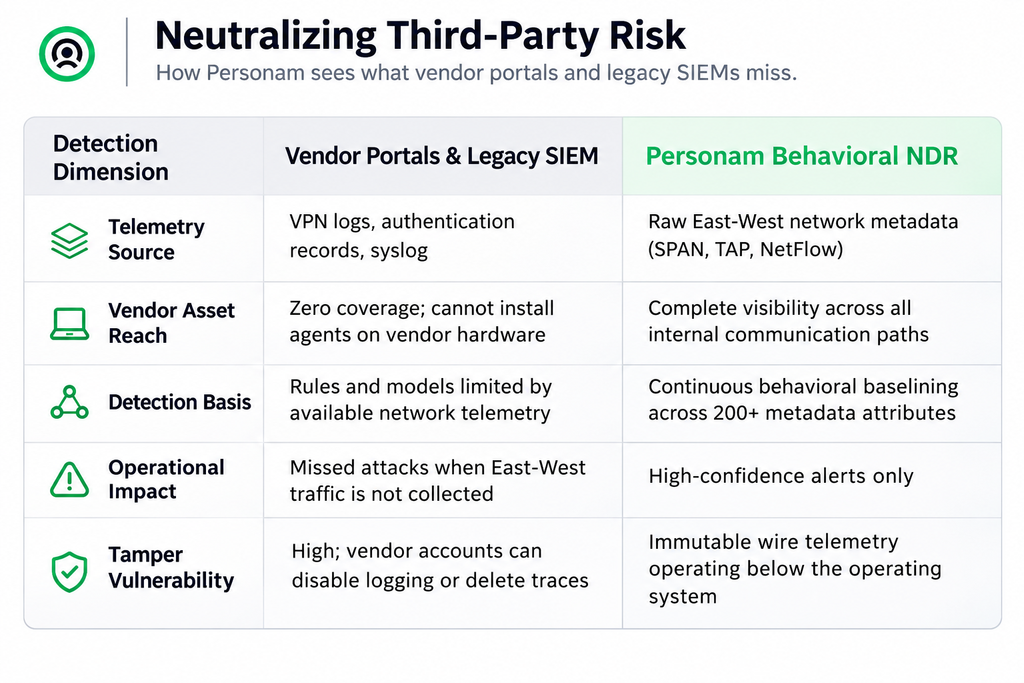
- The Endpoint Software Void: Enterprise security teams cannot install Endpoint Detection and Response (EDR) software on third-party hardware, vendor-managed maintenance appliances, or external partner workstations. The hospital has zero visibility into the health or process execution of the remote system connecting to its infrastructure.
- The Encrypted Tunnel Blindspot: Perimeter Next-Generation Firewalls (NGFW) inspect North-South ingress. When traffic arrives through an authorized VPN tunnel with valid partner credentials, the firewall treats the connection as authorized business traffic. Because internal traffic is encrypted (TLS 1.3), standard deep packet inspection cannot inspect payloads without breaking clinical connections.
- Lateral Movement Under Authorized Cover: Attackers who compromise vendor credentials do not deploy noisy automated exploit scripts. They live off the land. They use native administrative protocols like SMB, RDP, and WMI to stage reconnaissance, hopping from the vendor access point to core clinical databases.
Relying on log centralization inside a SIEM introduces unacceptable lag. Ingestion throttling, syslog parsing queues, and scheduled correlation queries mean supply chain intrusions are identified days after data exfiltration begins.
Line-Speed Behavioral Profiling for Third-Party Connections
Stopping vendor-based intrusions requires evaluating behavior at the network layer. Attackers can compromise third-party credentials, but they cannot hide their lateral network interactions. Every query, share enumeration, and data transfer creates network metadata.
Personam deploys passively at line speed, monitoring 100% of network traffic without host software agents or active network scans. By analyzing raw network metadata from physical TAPs, SPAN ports, and flow records, Personam extracts over 200 behavioral vectors per session. The platform inspects connection mechanics without decrypting or exposing sensitive patient health information (PHI).
Rather than relying on static firewall rules, Personam’s behavioral AI establishes continuous operational baselines across three tiers:
- Out-of-Character Drift: Personam evaluates a vendor connection against its own historical profile. If an imaging vendor maintenance account that normally pushes DICOM files at 2:00 AM suddenly initiates outbound SMB sessions to an internal financial subnet at noon, Personam flags the behavioral change.
- Out-of-Family Drift: Personam compares the connection against dynamic peer cohorts. If a billing partner’s jump box starts running directory enumeration over LDAP at volumes its peer systems never generate, Personam isolates the cohort deviation.
- Out-of-Organization Drift: The system evaluates activity against the entire enterprise baseline. Unprecedented communication paths between isolated vendor subnets and internal clinical databases surface immediately, even if the activity stays below static SIEM thresholds.
Rapid Containment Before Operational Disruption
Catching supply chain compromises during the lateral movement phase prevents widespread operational downtime. Personam identifies subtle protocol shifts and abnormal byte-transfer ratios within seconds of initial reconnaissance.
Security Operations Center (SOC) analysts receive clear alerts detailing:
- The originating vendor IP address and compromised credential identifier.
- The exact timestamp when network behavior drifted from baseline.
- The internal subnets, hosts, and administrative protocols targeted along the lateral path.
- Targeted investigative context to direct containment workflows.
With precise network-level intelligence, analysts do not waste hours parsing vendor access logs. They immediately revoke external session tokens and isolate internal target switch ports before an adversary can stage data or deploy ransomware payloads.
References & Citations
| Source / Framework | Reference Link | Key Findings & Context |
| Health-ISAC | 2025 Health Sector Cyber Threat Landscape | Identifies third-party vendor compromises and clinical supply chain dependencies as primary systemic risks. |
| CISA & HHS Joint Guidance | ICT Supply Chain Security Guidance | Outlines defensive strategies for managing indirect vulnerabilities across trusted software and vendor remote access. |
| MITRE ATT&CK Framework | Supply Chain Compromise (T1195) | Catalogs adversary tradecraft exploiting third-party services and trusted relationships to access internal networks. |
| Personam AI Architecture | Autonomous Behavioral Baselining & US Patent 9,609,010 B2 | Details technical implementation of 200+ metadata attributes, multi-level drift analysis, and agentless network baselining. |