Ransomware operations across healthcare facilities no longer begin with noisy, immediate file encryption. Modern Ransomware-as-a-Service (RaaS) affiliates operate with calculated restraint. Upon breaching an entry point, threat actors initiate low-and-slow internal reconnaissance, stage exfiltration pipelines, and target domain controllers over days or weeks. When the encryption payload finally triggers, hospital operations ground to a halt. Emergency rooms divert ambulances, electronic health record (EHR) systems go dark, and clinical care teams revert to paper charts.
Enterprise security architectures rely heavily on Endpoint Detection and Response (EDR) agents and perimeter firewalls to block these operational disruptions. On managed corporate workstations, EDR platforms perform well, catching known binaries and terminating unauthorized processes.
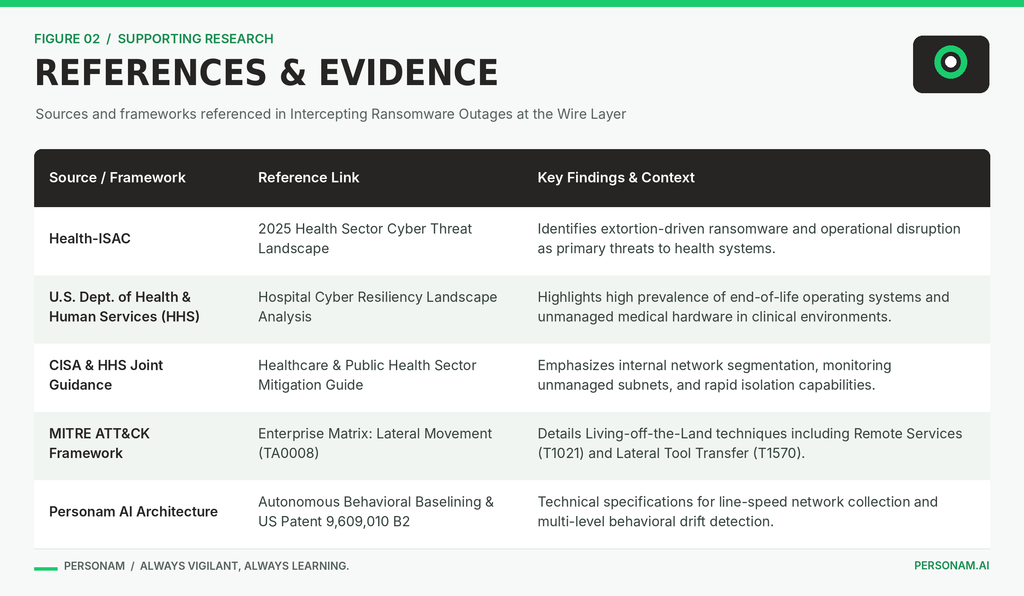
However, modern healthcare networks are not uniform corporate environments. Up to 70% of connected hospital infrastructure consists of unmanaged assets: legacy diagnostic workstations, building automation systems, and specialized Internet of Medical Things (IoMT) devices. Because these endpoints cannot host software agents, they represent an unmonitored staging ground for ransomware affiliates moving laterally across internal subnets.
The Staging Phase: How RaaS Capitalizes on Agentless Blindspots
Adversaries do not attempt to breach hardened endpoints directly. Instead, they exploit vulnerable edge devices or harvest legitimate credentials through spear-phishing to gain initial entry. Once inside, the attack sequence shifts from perimeter infiltration to East-West expansion:
- Internal Reconnaissance: The adversary queries local Active Directory structures, enumerates network shares, and identifies target subnets using native administrative protocols like SMB, RPC, and WMI.
- Silent Lateral Movement: Leveraging valid administrative credentials, the actor establishes remote sessions across internal subnets. Because the movement utilizes digitally signed operating system utilities, standard signature defenses see benign administrative activity.
- Data Staging & Exfiltration: Prior to triggering encryption, the adversary collects sensitive patient data and transfers micro-bursts to an unmanaged staging host or internal backup repository.
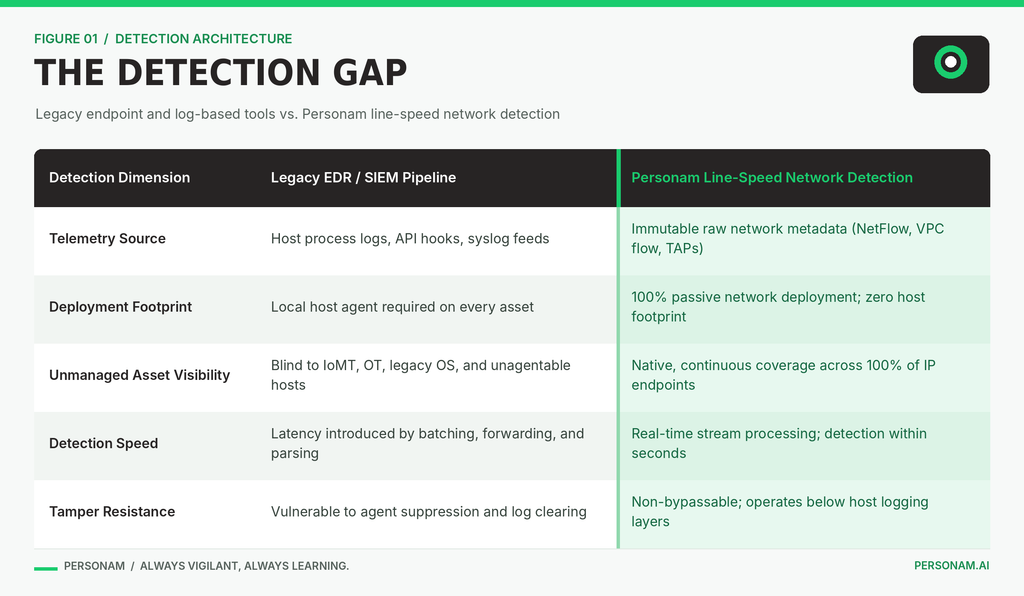
To host-centric security tools, this activity remains invisible. EDR agents only record process trees on endpoints where the agent is installed. If an adversary moves between an unmanaged pharmacy terminal and a legacy file server, host-level telemetry breaks down.
Centralizing event logs into a SIEM platform offers little relief. Log forwarders and parsing pipelines introduce minutes or hours of processing latency. Furthermore, adversaries routinely alter or clear local event logs to obscure their footprints. By the time a correlation rule triggers inside a SIEM console, data exfiltration is complete and ransomware execution is underway.
Line-Speed Behavioral Detection: Stopping Ransomware Before Encryption
Intercepting ransomware before operational downtime occurs requires shifting threat detection from host log files to the physical and virtual wire. An adversary can disable host security services or clear event logs, but they cannot perform lateral movement, query domain controllers, or stage data without transmitting packets across the network.
Personam addresses this architectural gap by deploying passively at line speed to monitor 100% of raw network traffic. Operating without endpoint agents or intrusive active scanning, Personam ingests network metadata—including TAP feeds, NetFlow, and cloud VPC flow logs—to extract over 200 behavioral vectors per session.
Rather than relying on static signatures or rigid correlation rules, Personam’s behavioral AI establishes dynamic baseline personas for every entity across the enterprise. The platform continuously compares device activity against its historical baseline and its designated peer cohort.
When a compromised account or unmanaged endpoint initiates out-of-character SMB sessions, displays irregular polling intervals, or causes unexpected byte-ratio shifts during data staging, Personam flags the behavioral drift immediately. Detection occurs at the wire layer within seconds of initial lateral movement, well before the adversary can deploy encryption routines or disrupt clinical systems.
Precision Telemetry for Security Operations
In high-stress clinical environments, security teams cannot afford false positives that distract from active threats or disrupt medical workflows. Personam eliminates alert noise by generating 3 to 5 high-fidelity behavioral alerts per 1,000 devices per week.
When an anomaly occurs, threat hunters receive concise context detailing:
- The precise originating IP address and user identity.
- The exact timestamp when behavioral drift began.
- The targeted internal assets involved in the lateral expansion path.
This structured context allows analysts to pivot into their existing EDR or network access control (NAC) platforms to isolate the compromised host immediately. Intercepting ransomware during the lateral movement and staging phases protects patient safety and maintains continuous clinical operations.