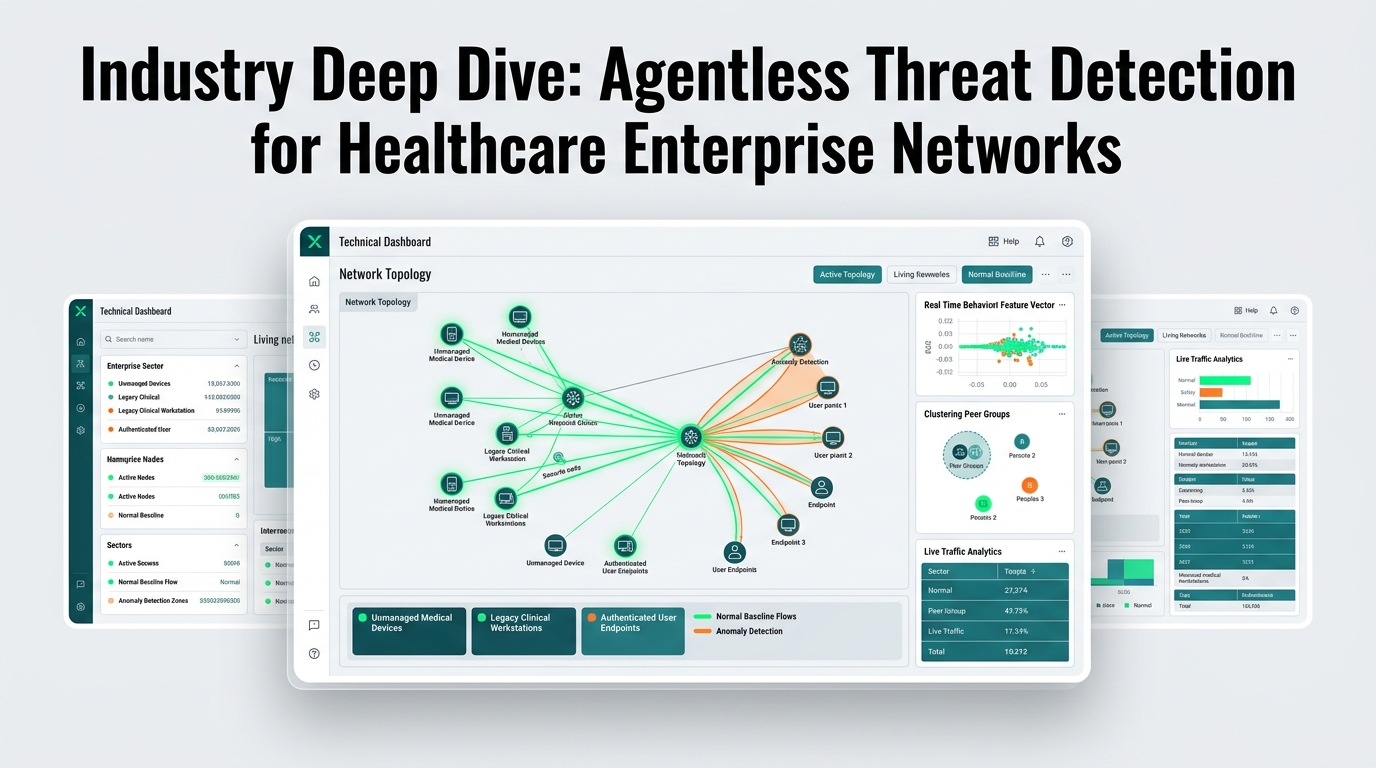
In modern healthcare enterprise security, traditional static perimeter defenses and endpoint detection and response (EDR) agents face critical operational boundaries. Complex medical environments feature thousands of unmanaged Internet of Medical Things (IoMT) devices, legacy clinical workstations unable to host intrusive agents, and third-party partner connections. In these heterogeneous networks, adversaries frequently bypass initial defenses using compromised legitimate credentials or “living off the land” (LotL) techniques—executing malicious actions through trusted administrative utilities like PowerShell, WMI, or SMB.
When an attacker operates using valid access rights, event logs and threshold-based alerts fail to illuminate the threat. For example, if a clinical account queries 50 patient records per hour during normal shifts, a static threshold rule set to trigger at 500 queries will fail to flag an adversary exfiltrating 40 records per hour continuously over several weeks. Conversely, lowering static thresholds to catch low-and-slow access patterns floods security operations centers (SOCs) with false-positive alerts, masking true operational threats in high-volume alert noise.
Authentication logs confirm who logged in, but raw log data alone cannot effectively validate whether the post-authentication behavior matches expected operational patterns. Effective security requires continuous evaluation of network behavior rather than reliance on static event logs.
Architecture of Agentless Behavioral Baselining
Agentless threat detection bypasses endpoint constraints by analyzing traffic directly at the network layer. Because every host—whether a managed administrative workstation, a legacy diagnostic terminal, or an IoMT device—must communicate across the network to function, network-level telemetry provides complete, unalterable visibility.
Instead of inspecting static host files or parsing text logs, an agentless behavioral detection architecture operates through passive network ingestion:
1. Feature Vector Extraction from Network Traffic
Passive network sensors tap raw traffic feeds at key switches and choke points. From these network feeds, the detection engine extracts compact behavioral feature vectors—capturing interaction patterns, protocol usage, data transfer characteristics, and device communication pairs without altering network packets or impacting clinical latency.
2. Peer Group Baselining and Unsupervised Learning
Rather than relying on static pre-configured rules, mathematical behavioral models construct peer groups by clustering entities with similar operational patterns. For instance, nurse practitioners on a specific clinical floor exhibit baseline communication profiles distinct from database administrators or bio-med equipment technicians. Baseline profiles are continuously established and updated without manual rule writing.
3. Sliding Temporal Windows for Dynamic Adaptation
Healthcare environments are constantly shifting due to rotation schedules, clinical protocol updates, and departmental reorganizations. By applying non-parametric statistics across sliding temporal windows, behavioral baselines adapt autonomously over time. This prevents baseline drift from generating false positives when normal clinical workflows evolve.
4. Statistical Outlier and Anomaly Detection
When a compromised account or infected IoMT device exhibits behavioral drift—such as a clinical workstation initiating administrative SMB sessions to an internal domain controller or querying unusual database segments—the engine identifies the statistical deviation immediately, quantifying risk based on mathematical deviation from established peer behaviors.
Comparing Detection Models: Log-Centric vs. Agentless Behavioral Telemetry
Healthcare CISOs evaluating architectural models must weigh operational overhead against detection capability across non-standard networks:
| Architecture Dimension | Traditional Log-Centric / EDR Approach | Agentless Behavioral Telemetry Approach |
|---|---|---|
| Endpoint Footprint | Requires local host software agents on every monitored asset. | Zero host footprint; 100% passive network monitoring. |
| IoMT & Legacy Coverage | Blind to unagentable medical devices and legacy clinical OS environments. | Full visibility across legacy systems, unmanaged IoMT, and guest endpoints. |
| Detection Mechanics | Static rule thresholds, known IOC signatures, and log event parsing. | Unsupervised peer group baselining and statistical anomaly detection. |
| Operational Drag | High agent maintenance, frequent patching, and heavy alert tuning. | Autonomous baseline adjustments via sliding temporal windows; low SOC noise. |
| Tamper Resistance | Logs and local agents can be disabled or modified by compromised credentials. | Network traffic cannot be altered or suppressed by compromised host software. |
Passive HIPAA Compliance Telemetry and Operational Relief
In addition to active threat detection, agentless network telemetry strengthens technical compliance with HIPAA Security Rule requirements (§164.312 Audit Controls and Access Control). Passive monitoring establishes verifiable audit trails of internal network interactions and data movement across EHR repositories without modifying underlying database structures or clinical software.
From an operational standpoint, switching to behavioral network telemetry delivers direct relief to overburdened SecOps teams:
- Significant Noise Reduction: By evaluating mathematical deviations across peer groups rather than firing alerts on simple static thresholds, security operations teams eliminate false-positive clutter—generating as few as 3 to 5 high-confidence alerts per 1,000 devices per week while maintaining high detection recall.
- Accelerated Threat Investigation: When an anomaly triggers, analysts receive structured contextual telemetry showing the exact behavioral drift, historical peer baselines, and lateral movement paths—eliminating hours of manual log aggregation.
- Safe Remediation Context: In clinical environments, automated security actions must be carefully targeted to avoid accidentally taking down critical healthcare delivery systems. Concise behavioral context enables human-in-the-loop decision-making so SOC teams can isolate compromised credentials or network ports without impacting patient care.
Securing Healthcare Enterprise Networks with Personam AI
As healthcare environments expand across acute care facilities, outpatient clinics, and connected medical device networks, defending the organization requires continuous visibility into internal behavioral dynamics. Relying solely on perimeter defenses and endpoint agents leaves critical infrastructure blind to compromised insider credentials and unagentable clinical devices.
Personam AI bridges this visibility gap by converting raw, unencrypted network traffic into high-fidelity behavioral intelligence. Operating entirely agentless across managed systems, unmanaged IoMT devices, and BYOD assets, Personam extracts lightweight behavioral feature vectors to establish dynamic peer groups without inspecting sensitive packet payloads or degrading clinical network performance. The platform serves as a force multiplier for security teams—surfacing clear, mathematically validated behavioral anomalies so human analysts can rapidly adjudicate alerts as benign, suspicious, or threatening.
To evaluate your organization’s internal network baseline and expose hidden behavioral drift without operational disruption, contact Personam to launch a zero-cost, 30-day proof-of-value pilot in your clinical environment.