Modern attackers move with valid accounts, trusted tools, and normal-looking activity. Personam learns how every user, device, and system actually behaves, then detects when that behavior changes. No rules. No signatures. No agents.
Every tool built around identity and known signatures has a blind spot. When an attacker, or a malicious insider, operates with valid access, traditional platforms see nothing. Personam sees behavior.
Valid logins mask malicious intent. Personam detects the shift in behavior, not just the identity behind it.
Security teams waste hours triaging false alarms generated by platforms that don't understand your actual network baseline.
Without individualized behavioral baselines, attackers move freely across your environment long before anyone notices.
Most security platforms were built for enterprise IT. Personam was built for environments where identity can't be trusted, devices can't run agents, and the wrong automated action could hurt someone.
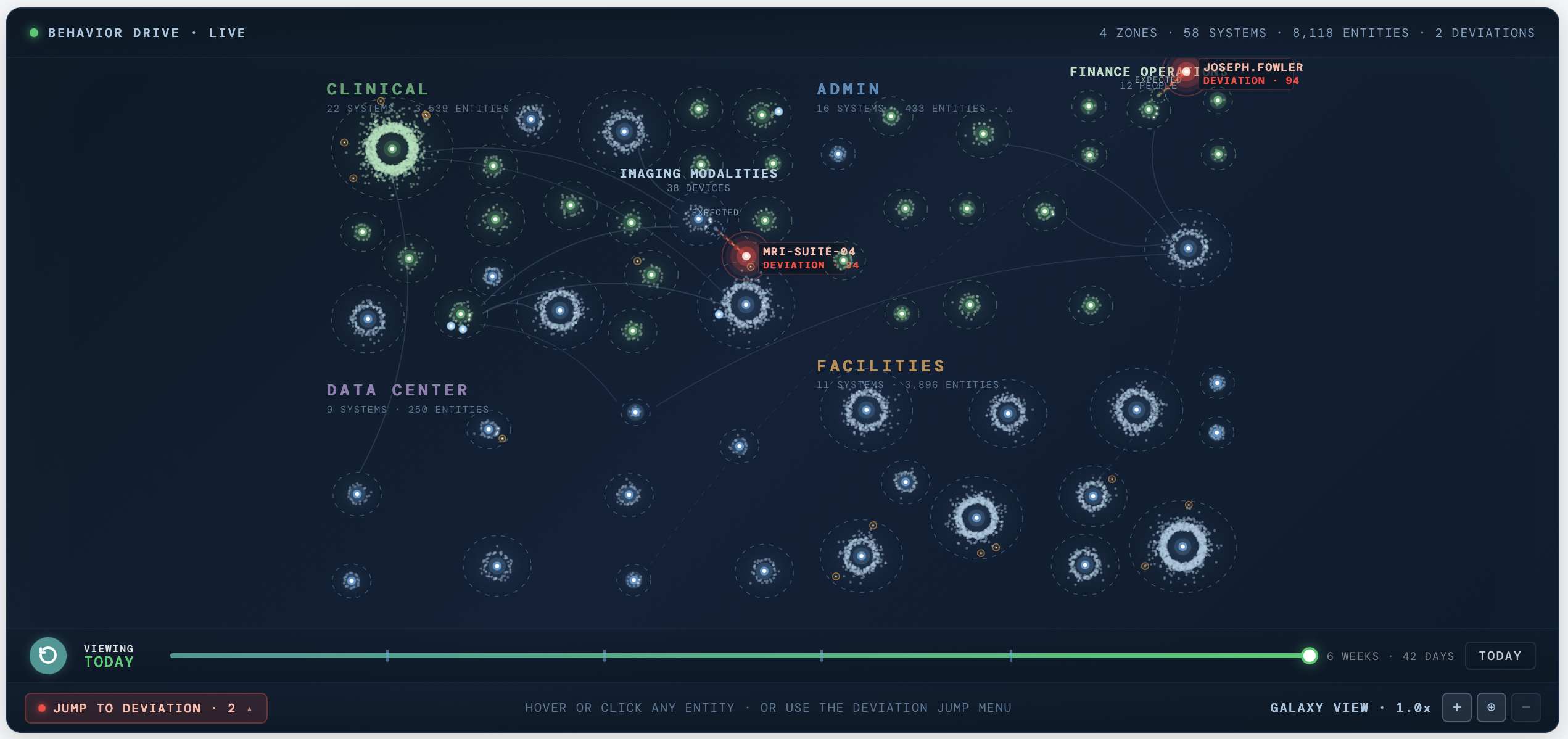
The behavioral intelligence engine. It builds a living map of 8,000+ entities, organized by behavioral family, profiled continuously. Behavior reveals org identity. Discovered, not configured. Every deviation visible the moment it happens.
Imaging systems, infusion pumps, PLCs, building controllers, legacy systems, the moment any device puts a packet on the network, its full behavioral footprint is visible. No agent. No exception.
No signatures. No pretrained models. No rules to write. Personam detects what no rule could anticipate, because it learned what normal looks like on your specific network.
Personam assembles the investigation for you, correlating related events, identifying the affected entities, and scoring the severity. Then leaves the response decision to your team. In environments where the wrong automated action has consequences, that design choice is everything.
Hour 0. One network tap or mirror port. Personam begins baselining immediately, no agents, no firewall changes, no configuration. Your team won't feel it go in.
Every entity profiled against every other simultaneously. A crowdsourced picture of normal that's unique to your environment, org identity discovered, not configured.
The map shows what behavior reveals. A server backing up somewhere the rest of its family never does. A senior insider staging client material at 3am. Both drawn from real detections, with names, devices, and figures anonymized. Both caught mid-creep, before a single rule could have flagged either.
New devices join. Patterns shift. Personam keeps learning every moment, adapting to your network as it evolves. One map. Every entity. Every deviation, visible.
Personam thinks like an agent, detecting, correlating, assembling the evidence. Response stays with your team. In environments where the wrong automated action carries real consequences, that design choice is everything.
Personam’s behavioral intelligence engine, rendering the map it has learned across your entire network. 8,000+ entities across operational, administrative, data center, and IoT zones, profiled continuously, every deviation surfaced the moment it drifts past tolerance.
Every entity measured against its peer family simultaneously. Behavior that looks normal in isolation, a senior insider reaching client material outside their own scope, can't hide from the full network picture.
Connecting individual detections into a single picture. Correlating events across time, entities, and network segments, then presenting the full case for your team to act on. See how modern attacks move →
Personam assembles the investigation, correlating behavioral signals across devices, credentials, time, and network segments. It identifies the affected entities, scores the severity, and presents the full picture so your team can act on it.
Your team reviews the full case and makes the call with the complete picture in front of them.
Personam keeps response under human control. It does not take automated action on your network. In a hospital the wrong automated response could take a patient monitor offline mid-procedure. On a plant floor it could halt a line. In a substation it could trip something that matters. This is a deliberate architecture, not a roadmap gap. It's why operators trust us on their networks.
The network
doesn't lie.
Every attacker has to put packets on the network. Valid credentials, compromised accounts, trusted tools, living-off-the-land techniques, it doesn't matter. The attacker still has to move. And movement leaves behavioral traces no rule could predict. The moment any entity communicates, Personam sees its full behavioral footprint, and knows when that footprint changes.
Imaging systems, PLCs, building controllers, legacy systems, covered from their first packet. No agent required, no exceptions.
Shared logins can't hide behavior. The attacker still has to move across the network, and the network records every step. How attacks move →
We work at the metadata layer. Nothing is decrypted. For environments that require it, Personam deploys fully on-premise with no data egress. The behavioral signal is in the session, not the payload.
Behavior Drive is Personam’s behavioral intelligence engine. It continuously builds a living behavioral map of your entire network, organized by behavioral family, zone, and system. It profiles every entity from its first packet and never stops learning.
Personam maps directly to continuous monitoring, anomalous activity detection, and access control requirements across every major regulatory framework.
View compliance frameworks →24/7 behavioral monitoring across every device, including the unagentable clinical, industrial, and building systems that most platforms leave unmonitored.
Behavioral baseline detection purpose-built to satisfy HIPAA §164.312(b) requirements, including shared credential environments where identity-based tools fail.
Every detected anomaly logged with full context, giving your compliance and legal teams the documentation they need when it matters most.
No slides. No pitch deck. We'll show you what Personam detects in an environment like yours, in under 30 minutes.