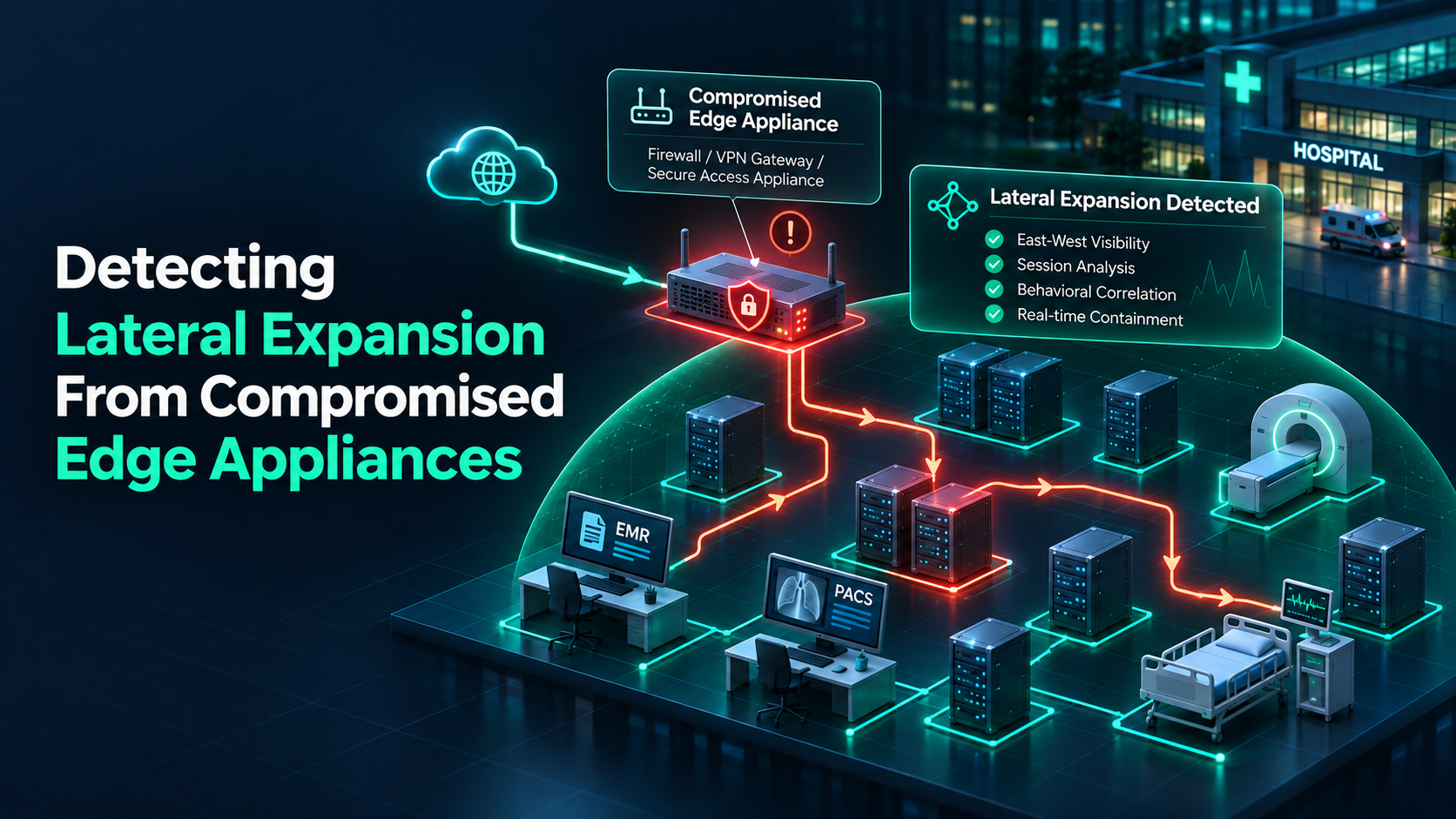
Edge appliances sit under constant targeting. Attackers actively scan the internet for known vulnerabilities in enterprise VPN gateways, remote access portals, and edge firewalls. When an exploit lands, the boundary collapses.
In a hospital operating around the clock, patching edge appliances is not as simple as clicking an update button. Systems support active patient monitoring, remote surgical consultations, and emergency telemetry. Taking gateways offline requires validation against clinical systems, scheduling downtime windows, and testing EHR connections. That operational lag creates an exposure window spanning days or weeks.
Attackers do not linger on the edge device once they gain access. They pivot inward, using the compromised boundary host as an unmonitored launchpad into internal network segments.
The North-South Blind Spot
Enterprise security stacks are built on an outdated premise: inspect the perimeter boundary and install agents on managed workstations. When an adversary exploits an edge device, this architecture fails across two operational fronts:
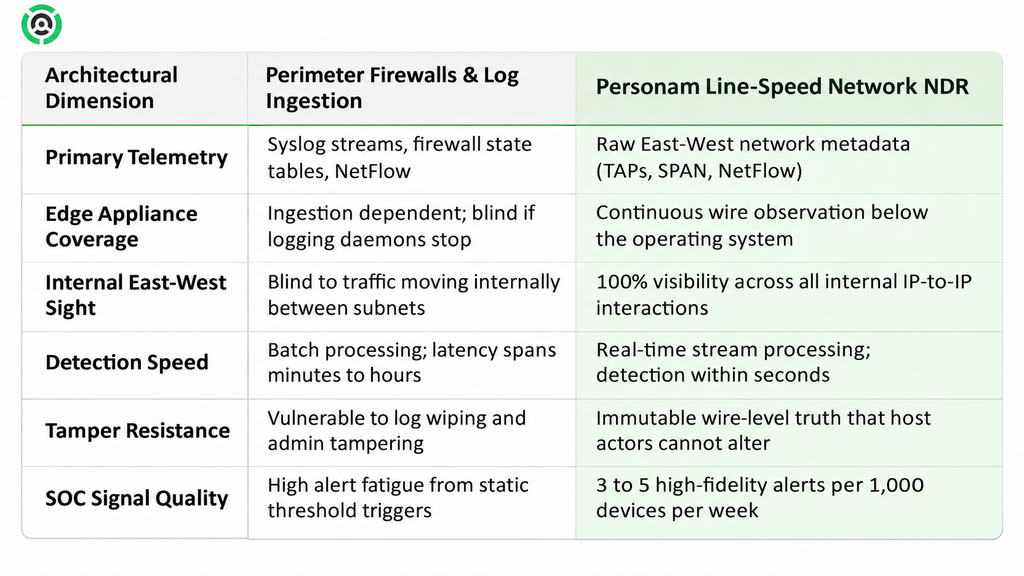
- Firewalls Look Outward: Next-Generation Firewalls (NGFW) inspect North-South traffic passing between the internal network and the internet. Once an adversary compromises an edge VPN concentrator, their subsequent actions move East-West. Internal reconnaissance, SMB share enumeration, and RPC execution flow laterally between internal subnets. Outward-facing perimeter tools cannot see this traffic.
- The Agent Software Void on Edge Appliances: Security teams cannot install Endpoint Detection and Response (EDR) software on proprietary edge appliances, VPN gateways, or network access hardware. These systems run closed firmware. Without a local software agent, the endpoint security stack provides zero visibility into process execution or local command abuse.
Falling back on syslog feeds introduces dangerous delays. Event logs generated by edge gateways must be batched, forwarded, parsed, and indexed by a SIEM. Ingestion queues introduce latency, and attackers operating with administrative access routinely disable logging daemons or clear local audit trails. By the time a correlation rule triggers in an analyst queue, the attacker has already mapped internal subnets and established persistent command sessions.
Line-Speed Layer 3 Behavioral Collection
Stopping edge intrusions requires shifting detection from the compromised boundary device to the internal network wire. An attacker can tamper with appliance logs or compromise administrative credentials, but they cannot perform lateral movement without transmitting packets across internal switches.
Personam deploys passively at line speed, monitoring internal network traffic without installing software agents or running disruptive active scans. By analyzing raw network metadata from physical TAPs, SPAN ports, and flow records, Personam tracks over 200 behavioral vectors per session.
Rather than relying on static signatures or rigid rules, Personam’s behavioral AI establishes dynamic baselines across three distinct levels:
- Out-of-Character Drift: Personam evaluates the edge appliance against its historical baseline. If a VPN gateway that normally routes external client traffic suddenly initiates outbound SMB sessions to an internal diagnostic server, Personam flags the behavioral shift immediately.
- Out-of-Family Drift: Personam measures the device against its peer cohort. If one access gateway begins polling internal Active Directory controllers over LDAP at volumes its peer appliances never generate, Personam isolates the cohort deviation.
- Out-of-Organization Drift: The platform evaluates connections against enterprise-wide communication baselines. Rare internal destinations and anomalous protocol pairings surface as outliers, alerting analysts to new paths cut across internal subnets.
Detecting Lateral Expansion Before Data Staging
When an edge exploit occurs, Personam detects the initial lateral probing at the network layer within seconds.
Operating below the operating system log layer removes the delay of batch log processing. Analysts receive structured, context-rich alerts containing:
- The exact originating internal IP address of the compromised edge system.
- The specific timestamp when anomalous East-West probing started.
- The targeted internal subnets, hosts, and protocols involved in the lateral expansion path.
Equipped with this wire-level intelligence, security operations teams avoid wasting hours parsing fragmented syslog feeds. They can immediately isolate the affected network port or invoke firewall access-list changes, terminating the intrusion before data staging or ransomware deployment begins.
References & Citations
| Source / Framework | Reference Link | Key Findings & Context |
| CISA (Cybersecurity & Infrastructure Security Agency) | Mitigation Guide: Healthcare & Public Health Sector | Identifies external exposure and delayed patching of edge devices as critical vulnerabilities in healthcare. |
| CISA Known Exploited Vulnerabilities Catalog | CISA KEV Catalog | Tracks actively weaponized vulnerabilities targeting edge VPN gateways and remote access appliances. |
| Health-ISAC | 2025 Health Sector Cyber Threat Landscape | Notes widespread exploitation of internet-facing systems as a primary operational disruption vector. |
| MITRE ATT&CK Framework | Exploit Public-Facing Application (T1190) | Outlines adversary tradecraft exploiting perimeter services to gain initial footholds and move laterally. |
| Personam AI Architecture | Autonomous Behavioral Baselining & US Patent 9,609,010 B2 | Technical specifications for line-speed metadata extraction and multi-level behavioral drift detection. |