
Generative AI has fundamentally changed initial access mechanics. Attackers no longer rely on poorly worded emails or obvious phishing links to harvest credentials. AI-assisted campaigns now produce convincing messages and cloned voices which attackers pair with adversary-in-the-middle (AiTM) proxies that bypass multifactor authentication (MFA) and with calls that talk service desk staff into resetting credentials.
Once adversaries obtain valid Active Directory credentials, the initial breach phase concludes. The attack transitions to internal expansion.
To Identity and Access Management (IAM) platforms and Security Information and Event Management (SIEM) consoles, an authentication using valid credentials can appear benign. Traditional identity tools confirm who authenticated, but they are not built to evaluate whether post-authentication behavior aligns with legitimate operational needs.
The Post-Authentication Gap: Where Identity Controls Stop
Social engineering bypasses perimeter controls by abusing trust rather than exploiting software code. When an attacker successfully authenticates using stolen credentials, traditional security architectures leave three gaps:
- Valid Access Rights: Because the authentication ticket or session token is valid, IAM platforms, Single Sign-On (SSO) gateways, and Privileged Access Management (PAM) controls treat the connection as authorized.
- Log Processing Latency: Centralized SIEM pipelines rely on syslog ingestion and event parsing. Normalization and correlation add further delay, and many detections run as scheduled searches, so credential abuse can surface well after it begins.
Static Threshold Blindspots: Rule-based detection systems flag activity only when static limits are breached (e.g., more than 100 database queries per minute). Attackers operating under “low and slow” tradecraft query assets gradually over days, remaining undetected below static thresholds.
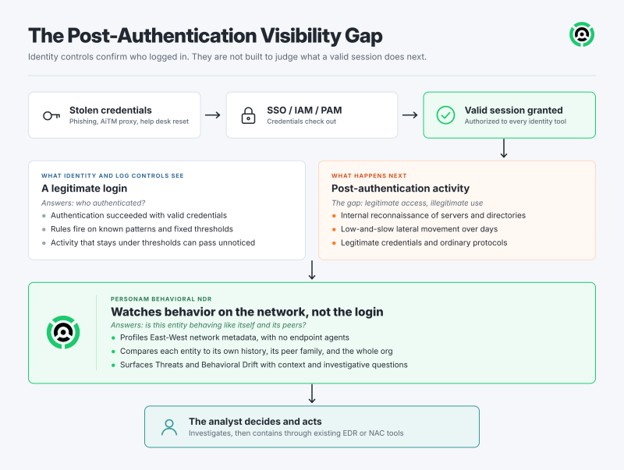
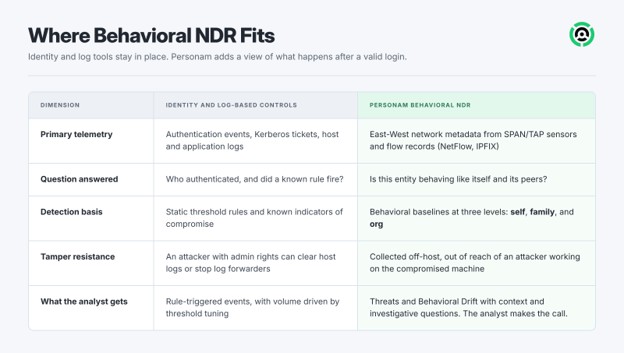
Event logs alone are not enough to catch credential abuse. Adversaries with administrative privileges can alter local log files or suppress log forwarders. Even when logs remain intact, log data alone does not show whether a user’s network traffic matches their expected peer baseline.
Continuous East-West Profiling: Detecting Behavioral Drift
Catching credential abuse requires evaluating continuous post-authentication behavior directly at the network layer. Every entity, whether an end-user workstation, developer terminal, or server, must communicate across the network wire to function. Because network metadata is collected off-host, an attacker working on a compromised machine cannot erase it the way they can clear local logs.
Personam deploys passively, observing traffic on monitored network segments without installing host software agents or running active scans. It analyzes network metadata from physical SPAN/TAP connections and flow records such as NetFlow and IPFIX, building a behavioral profile of every entity it observes.
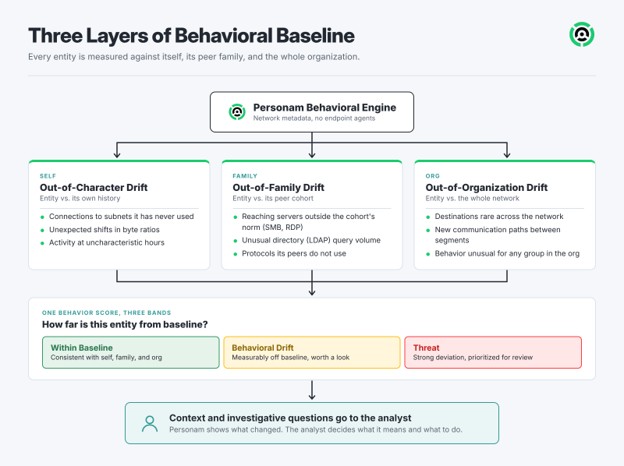
Rather than relying on static rules, Personam’s behavioral AI establishes dynamic baselines at three levels:
- Out-of-Character Drift: Evaluates an individual entity’s activity against its own historical baseline. If an account suddenly accesses novel subnets, initiates SMB/RPC connections at unusual hours, or exhibits unexpected byte-ratio shifts, Personam surfaces the change as Behavioral Drift.
- Out-of-Family Drift: Compares an entity’s actions against its dynamic peer cohort. For example, nurse practitioners on an acute care floor share similar network communication patterns. If a single nurse practitioner workstation begins enumerating the directory over LDAP at volumes its peers never reach, or opening SMB and RDP sessions to servers outside the cohort’s normal reach, Personam surfaces the deviation from its family.
Out-of-Organization Drift: Compares an entity’s behavior against the network as a whole. Destinations that are rare across the organization, or new communication paths between network segments, stand out even when an entire peer cohort has shifted together.
From Drift to Decision: What the Analyst Sees
When an adversary uses stolen credentials to conduct internal reconnaissance or move laterally, Personam is designed to surface the behavioral drift at the network layer as it develops, rather than after logs are collected and parsed.
Because it analyzes network metadata directly, Personam does not depend on host log collection. Security Operations Center (SOC) analysts receive a Threat or Behavioral Drift finding with context, including:
- The user account and originating IP address involved.
- When the behavioral drift began.
- The internal subnets, hosts, and protocols the entity reached.
- Investigative questions to guide the analyst’s next steps.
With that context, analysts decide whether the activity is malicious and, if so, pivot into their existing EDR or Network Access Control (NAC) tools to revoke session tokens and isolate the host, aiming to contain it before data leaves the network.
References & Citations
| Source / Framework | Reference Link | Key Findings & Context |
| Federal Bureau of Investigation (FBI) | FBI Warns of Increasing Threat of Cyber Criminals Utilizing Artificial Intelligence (May 2024) | Warns of AI-powered phishing, social engineering, and voice and video cloning against individuals and businesses. |
| Health-ISAC | 2025 Health Sector Cyber Threat Landscape | Members ranked phishing and compromised credentials among the top threats their organizations faced in 2024. |
| MITRE ATT&CK Framework | Valid Accounts: Domain Accounts (T1078.002) | Details adversary abuse of legitimate credentials to bypass initial access controls and move laterally. |