May 23, 2026
Healthcare leaders often picture cyberattacks as loud events. A ransomware screen appears. Systems lock up. Phones start ringing. Clinical operations slow down. Everyone knows something is wrong.
But many of the most dangerous attacks in hospital environments do not begin that way. They begin quietly, with valid credentials, normal-looking administrative activity, and tools the organization already trusts. A PowerShell session. A remote management utility. A sanctioned cloud service. A service account behaving just differently enough to matter — but not obviously enough to trigger a static alert.
That is the real risk healthcare organizations need to focus on now. AI is helping attackers move through environments faster, adapt more quickly, and blend into operationally normal activity with less effort than before.
- AI is making lateral movement in hospital networks faster, quieter, and harder to distinguish from legitimate administrative activity
- The most serious healthcare attacks increasingly rely on valid access and trusted tools, not noisy malware
- AI helps attackers accelerate reconnaissance, phishing, scripting, and movement between systems
- Hospital environments are especially vulnerable — legacy systems, unagentable devices, operationally sensitive infrastructure
- Static detection struggles when the tool is allowed and the credential is valid
- Behavioral detection surfaces abnormal relationships and out-of-family activity before quiet movement becomes operational damage
The Problem Is Not Just Malware
Security discussions in healthcare often default to malware-centric thinking. That framing is understandable, but incomplete. In many modern intrusions, the attacker does not need to deploy something obviously malicious. If they can get a user to click, reuse a credential, abuse remote administration, or pivot through a sanctioned toolset, they can move across the network while looking uncomfortably similar to legitimate activity.
This matters even more in healthcare because hospitals are designed for availability, interoperability, and speed. Systems have to talk to one another. Clinical workflows cannot stop every time a security question arises. Operational trust between users, devices, and services is high by necessity. Attackers know this. AI increases their ability to exploit it.
What AI Changes for the Attacker
The better claim is practical, and urgent: AI is improving attacker throughput. That means faster open-source research. Faster phishing refinement. Faster scripting. Faster adaptation when something in the target environment does not behave as expected. Faster interpretation of credentials, permissions, and internal relationships. Faster decisions about what to try next.
Recent reporting from Microsoft, OpenAI, and Google has already shown that threat actors are using large language models for operational support tasks — reconnaissance, scripting assistance, translation, phishing content, and malware-evasion research. That alone changes the economics of intrusion activity
A hospital attacker doesn’t need AI to invent a new class of exploitation. They just need AI to shorten the time between foothold and lateral movement.
Why Hospital Environments Are Uniquely Exposed
Hospitals are not generic enterprise networks. They are dense, heterogeneous, and operationally fragile environments. A typical hospital network includes standard workstations, shared clinical workstations, BYOD and contractor devices, medical devices and IoMT, facilities infrastructure, legacy systems, cloud services and remote administration workflows, and service accounts that are business-critical.
A large percentage of those systems are unagentable or operationally sensitive. Security teams may not be able to install endpoint tooling on them. That means defenders often have incomplete endpoint visibility in the exact places where attackers want to move. Hospitals also generate a massive amount of legitimate east-west traffic — which gives attackers cover.
How Lateral Movement Actually Happens
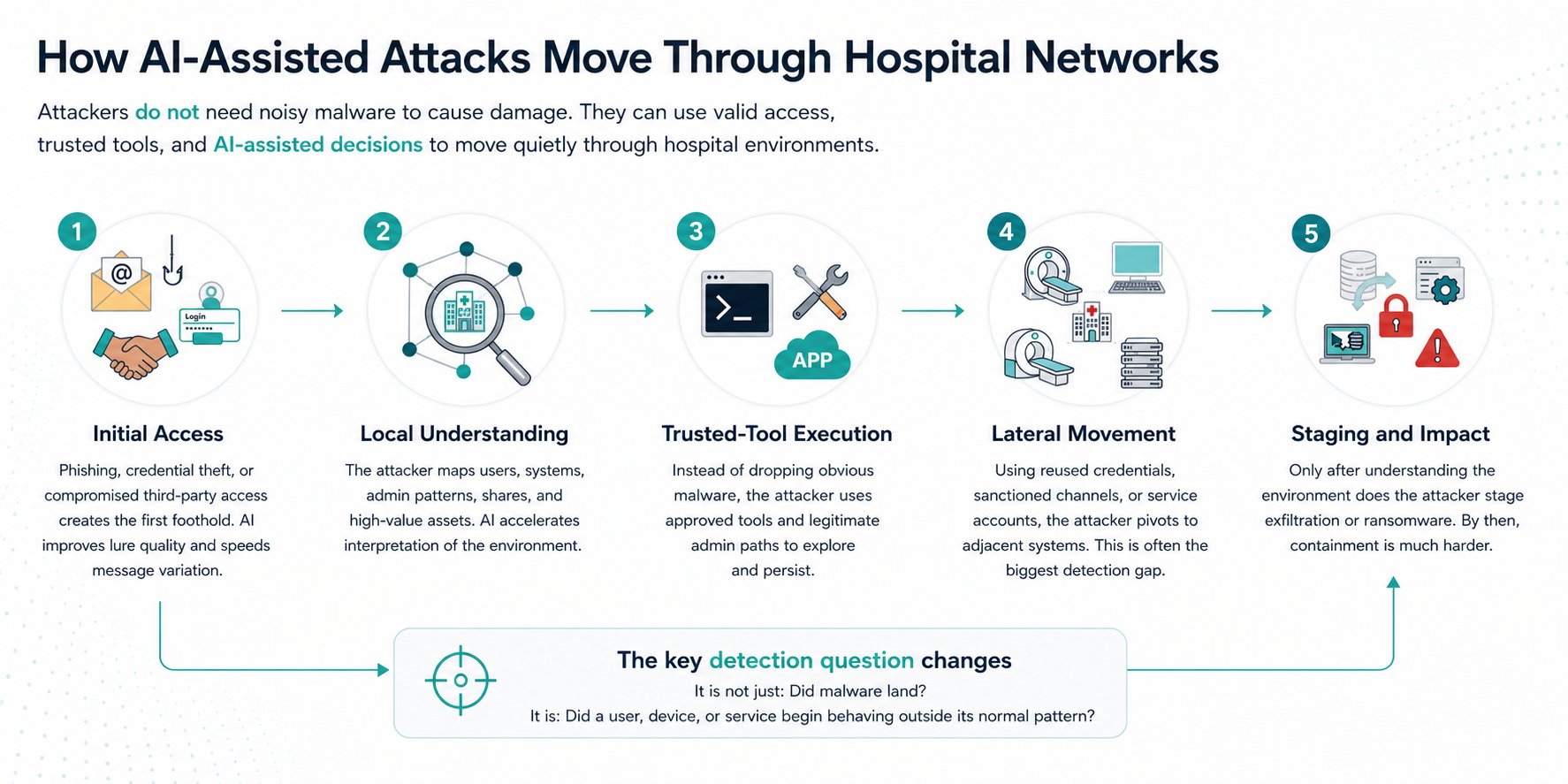
The most dangerous moment in many attacks is not the initial compromise. It is the pivot that follows. A realistic attack progression in a hospital environment often looks like this:
The most important detection question is not “Did malware land?” It is “Did a user, device, or service begin behaving outside its normal pattern?”
Trusted Tools Are Now Part of the Attack Path
Trusted-tool abuse can include PowerShell, RDP, Windows administrative utilities, remote monitoring and management platforms, sanctioned scripting environments, approved cloud communication channels, and service accounts used outside their normal role. None of these tools is malicious by default. That is precisely the problem.
If a threat actor uses malware, a defender may have a chance to match a signature. If the actor uses a valid admin path, an approved utility, or an account that already belongs in the environment, the signal is much weaker. In healthcare, this is especially dangerous because many privileged actions have legitimate clinical or operational explanations.
Why Behavioral Visibility Matters More
Even when attackers use legitimate tools, they still have to create outcomes. They have to touch systems they do not usually touch. They have to authenticate in new ways. They have to form unusual relationships between users, devices, services, and peers. They have to move. Those changes create detectable deviations.
That is where agentless behavioral detection becomes strategically important — especially in healthcare environments with incomplete endpoint coverage. Personam is built for environments where the most important signals are not always visible through endpoint software. By analyzing network metadata and modeling expected behavior across users, devices, and services, Personam identifies when something begins acting out of family — whether or not the wrapper looks legitimate.
What Each Approach Sees
- An authorized user logged in normally
- A legitimate admin tool being used
- Traffic below threshold, no rule fires
- No known-bad signature present
- Entity behavior outside its established baseline
- Communication with a new peer group, first contact
- Credential operating outside its historical scope
- Device reaching a subnet it has never reached before
The payload keeps changing. The behavioral deviation always reveals itself. That is the structural advantage of watching how things behave rather than what artifacts they carry.
The Executive Takeaway
The next major hospital breach may not begin with obviously malicious software. It may begin with valid access, trusted tools, and AI-assisted decisions that help an attacker move faster than the environment can interpret. Healthcare teams need behavioral clarity across the environment — especially where endpoint visibility is incomplete.
The hospital networks that will hold up best are the ones that can see when trusted tools stop behaving like trusted tools.
- Microsoft Security: Staying ahead of threat actors in the age of AI
- OpenAI: Disrupting malicious uses of AI by state-affiliated threat actors
- Google Cloud / GTIG: Adversarial Misuse of Generative AI
- CISA / NSA / MS-ISAC: Protecting Against Malicious Use of Remote Monitoring and Management Software
See what Personam finds in your network. Live demo, 30 minutes.
Schedule Demo