
The Day 1 Acquisition Blind Spot
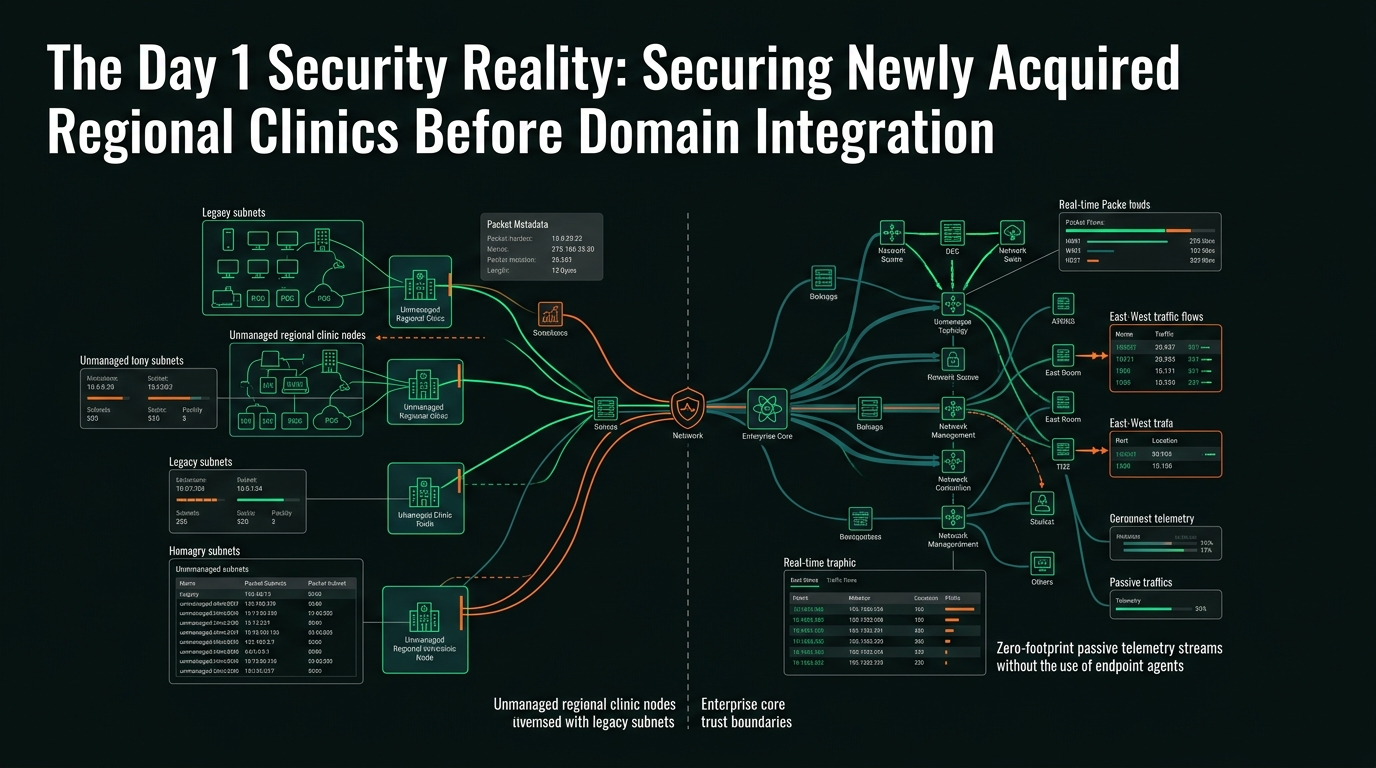
On Monday morning, the parent health system enables network connectivity to a newly acquired regional clinic. Active Directory consolidation remains weeks or months away. The regional site operates with legacy subnets and unmanaged administrative terminals. Enterprise security teams face immediate exposure: transitional network trusts grant broad access across domain boundaries while offering zero visibility into internal East-West traffic.
Acquisition roadmaps naturally prioritize financial and clinical integration. Domain consolidation and identity synchronization lag behind out of operational necessity. Attackers exploit this gap. Compromised credentials harvested from regional endpoints allow adversaries to pivot into the enterprise core without triggering single-sign-on alerts or perimeter security tools.
Domain boundaries do not stop network routing. When network routes open before identity governance aligns, the enterprise attack surface expands instantly.
Why Endpoint Agents and Legacy SIEMs Fail in Clinical Environments
Traditional enterprise defense playbooks depend heavily on two main pillars: installing Endpoint Detection and Response (EDR) software on every asset, and centralizing log data into a Security Information and Event Management (SIEM) pipeline. In a newly acquired regional clinic, both pillars break down immediately.
Research from the HHS 405(d) Hospital Cyber Resiliency Initiative highlights that 96% of hospitals report operating end-of-life operating systems or software, including unmanaged medical devices. Furthermore, HHS 405(d) reports that active network scanning has disrupted medical devices in practice. Consequently, security teams cannot rely on intrusive discovery or agent deployment without introducing clinical operational risk.
1. The Endpoint Agent Gap on Unmanaged Clinical Gear
Healthcare environments are populated by specialized workstations, diagnostic modalities, pharmacy terminals, and legacy subnets. These systems present unique deployment challenges:
- Vendor Support Constraints: Installing host agents on specialized clinical hardware and diagnostic equipment risks clinical downtime or voids vendor software support.
- System Overhead and Downtime Risks: Legacy hardware in regional facilities frequently lacks the processing capacity required for modern EDR agents, risking system crashes or latency during patient care operations.
- Infrastructure Prerequisites: Pushing endpoint agents en masse requires a centralized management domain, active directory integration, and software deployment pipelines that simply do not exist in transitional acquisition environments.
2. The SIEM Log-Latency Delay
When host agents cannot be installed, security teams often fall back on centralizing log data into a SIEM platform. In decentralized clinical environments, log-based monitoring creates critical operational delays:
- Ingestion Queues and Throttling: Network bandwidth throttling and log ingestion queues produce parsing latency spanning hours or days.
- The Attacker Speed Advantage: HHS 405(d) analysis indicates that 71% of attacks are non-malware intrusions, with credential misuse playing a central role. Attackers execute credential dumping and lateral movement within minutes of initial access. By the time a SIEM parses syslog events, data exfiltration is already complete.
Day 1 Visibility: Agentless Behavioral Telemetry
Overcoming the acquisition visibility gap requires monitoring network behavior directly at the physical and virtual wire. Personam solves this challenge through agentless packet-metadata behavioral analysis. Deploying passively via SPAN ports or network TAPs, Personam analyzes network traffic in real time without modifying traffic flows or touching sensitive clinical endpoints.
Deployment takes hours rather than weeks. Upon activation, Personam establishes a baseline of network normalcy instantly. Instead of searching for static signatures or waiting for parsed syslog pipelines, Personam evaluates machine-to-machine interactions, identifying anomalous East-West traffic and unauthorized Kerberos ticket requests across domain boundaries.
Comparing Day 1 Defense Strategies in Healthcare M&A
| Security Vector | Agent-Based & SIEM Model | Personam Agentless Telemetry |
|---|---|---|
| Deployment Timeline | Weeks to months across disparate endpoints | Hours via passive SPAN/TAP installation |
| Endpoint Overhead | High footprint; destabilizes legacy clinical devices | Zero footprint; completely agentless and non-intrusive |
| Detection Speed | Delayed by log ingestion queues and parsing pipelines | Real-time behavioral analysis on wire data |
| Cross-Domain Visibility | Blind to unmanaged assets outside Active Directory | Full East-West visibility across transitional networks |
Neutralizing Transitional Trust Exploitation
Credential exploitation represents the primary tradecraft used during healthcare mergers and acquisitions. Attackers leverage valid user credentials harvested from regional workstations to authenticate across cross-domain trusts. Because the authentication appears legitimate to identity providers, traditional rule-based alerts remain silent.
Behavioral intelligence changes the defense equation. Personam maps historical access patterns and machine behavior for every entity across the network. When a regional workstation suddenly initiates out-of-character RPC calls to an enterprise domain controller, Personam identifies the structural behavioral anomaly immediately.
Precision matters in high-stakes environments. Security analysts receive high-confidence contextual signals detailing the exact network deviation without wading through thousands of redundant log alerts or false positives.
Supporting Clinical Operations and SOC Efficiency
Healthcare security teams operate under extreme resource constraints and elevated risk. Forcing Security Operations Center (SOC) analysts to manually parse incomplete syslog feeds from newly acquired clinics increases operational burnout and slows response times when minutes count.
Behavioral telemetry serves as a force multiplier for security architects and operational teams. By analyzing real-time network interactions at the wire level, Personam delivers definitive detection without requiring endpoint modifications, software installations, or complete domain integration. Security leaders maintain continuous visibility and control across the expanding enterprise, securing clinical care environments from Day 1.