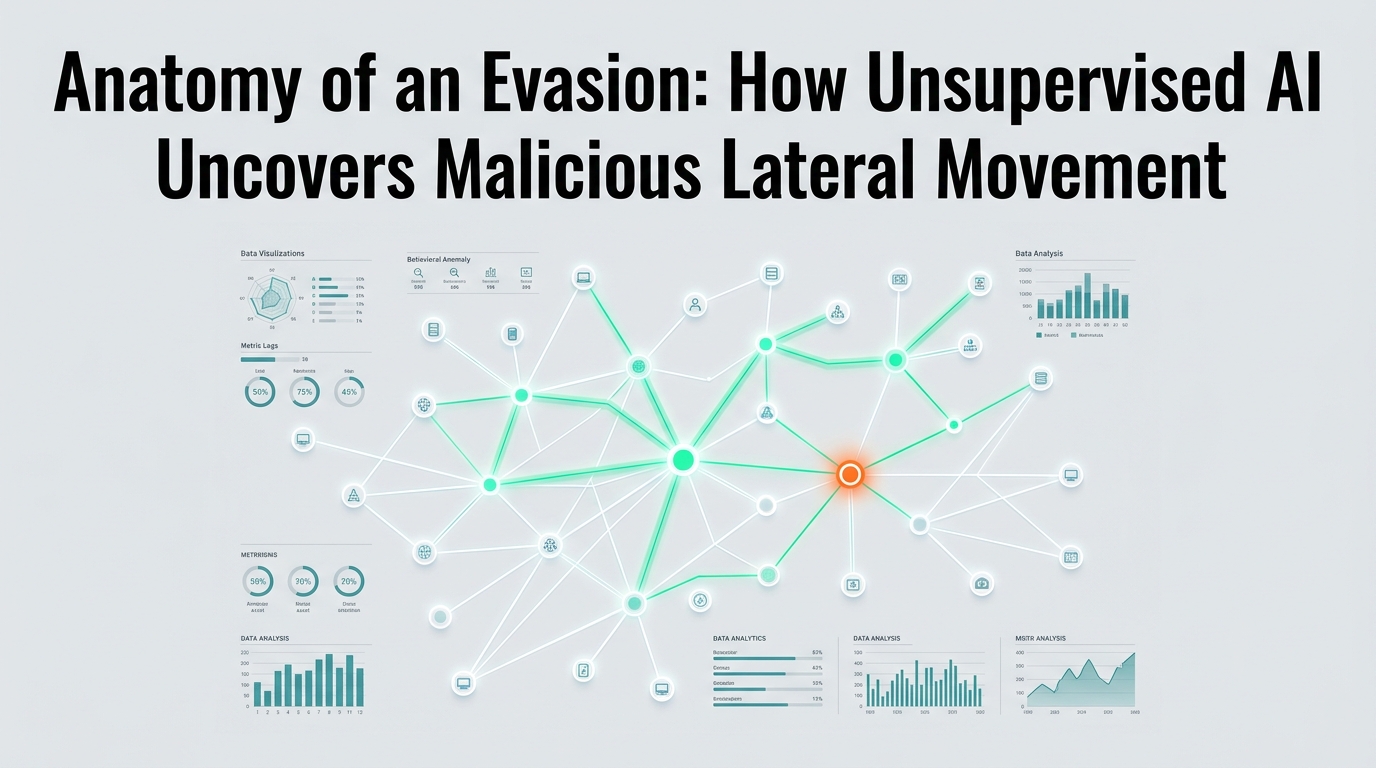
The Blind Spot in Modern Enterprise Defense
Modern enterprise security stacks are increasingly adept at catching known malicious binaries, standard ransomware payloads, and flagged command-and-control IP addresses. However, sophisticated adversaries and insider threats rarely rely on public malware once inside an enterprise perimeter. Instead, they execute Living-off-the-Land (LotL) tactics—utilizing legitimate administrative tools like PowerShell, WMI, Remote Desktop Protocol (RDP), and native Windows network protocols to move stealthily between systems.
Because these administrative binaries are digitally signed, trusted by operating systems, and routinely executed by network administrators, traditional Endpoint Detection and Response (EDR) agents and log-centric SIEM platforms often fail to detect them. To standard signature-based controls and static rule sets, an adversary conducting lateral movement using valid administrative credentials appears entirely indistinguishable from normal IT operations.
Phase 1: Initial Access and Low-and-Slow Reconnaissance
An attack sequence typical of stealthy lateral movement begins when an adversary compromises an initial entry point—such as a user workstation or an unmanaged IoT device—via stolen credentials, phishing, or a zero-day vulnerability. Rather than immediately launching high-volume port scans or deploying noisy malware, the actor establishes persistent access and initiates quiet reconnaissance.
During this stage, the adversary queries local active directory structures, enumerates network shares, and inspects native service configurations using standard system commands. Because individual command executions generate minimal host-level logging noise and utilize native operating system features, host agents record these events as benign user activity.
Phase 2: Living-off-the-Land Lateral Movement
Once internal targets are identified, the adversary initiates lateral movement to escalate privileges and access high-value targets, such as staging servers containing sensitive intellectual property or customer data. By relying exclusively on legitimate management protocols (such as SMB/RPC or WinRM), the threat actor establishes sessions across internal network segments.
To illustrate how subtle behavioral shifts manifest in practice, consider the following illustrative walkthrough of a Living-off-the-Land attack scenario involving internal workstation traffic:
- Credential Re-Use: The adversary leverages valid administrative credentials obtained during initial reconnaissance to authenticate across internal subnets.
- Protocol Micro-Variations: Session metrics display subtle timing anomalies—such as non-standard session durations, irregular polling intervals, or uncharacteristic peer-to-peer connection paths—that deviate from the originating user’s normal routine.
- Anomalous Data Transfer Volumes: As the adversary stages data for exfiltration, internal network metadata reveals an unexpected shift in byte ratios. Micro-bursts of internal traffic flow toward a staging server that historically receives minimal inbound volume from the originating subnet.
Illustrative Telemetry Breakdown
Observed Event: Outbound SMB/RPC session initiated from internal workstation Finance-WS-08 to staging host Staging-Svr-02.
Traditional EDR/SIEM Status: PASSED (Valid administrative credentials, native Windows binary, no known signature match).
Personam Unsupervised AI Status: ALERT GENERATED (Cohort anomaly detected: protocol usage pattern deviates significantly from historical peer group baseline; unexpected internal volume spike).
Phase 3: Autonomous Interception Prior to Exfiltration
Operating agentlessly by analyzing raw network metadata—such as NetFlow, VPC flow logs, or lightweight network taps—Personam maintains visibility across 100% of internal IP-enabled devices, including unmanaged endpoints, IoT devices, and legacy infrastructure.
Without requiring manual rule configurations, static signatures, or prior threat intelligence updates, Personam’s multi-level behavioral analysis correlates protocol micro-variations across the network in real time. Rather than flooding the SOC with unprioritized low-level alerts, Personam collapses noise and delivers context-rich alerts that pinpoint:
- The exact originating device and user identity.
- The precise timestamp when anomalous lateral behavior began.
- The target internal assets involved in the lateral expansion path.
By detecting behavioral deviations during the lateral movement phase, security operations teams can isolate compromised endpoints and revoke session tokens well before an adversary can stage or exfiltrate sensitive data.
Comparative Analysis: Traditional Defense vs. Unsupervised AI
The table below summarizes how traditional security approaches compare against self-learning network behavioral AI when mitigating silent lateral movement:
| Capability Vector | Legacy EDR / SIEM Approach | Personam Unsupervised Behavioral AI |
|---|---|---|
| Detection Basis | Known malware signatures, host event logs, and static rule sets. | Patented multi-level behavioral anomaly detection across 200+ network attributes. |
| Device Coverage | Limited to managed endpoints with active host agents installed. | 100% agentless network coverage across all IP entities (unmanaged endpoints, IoT, BYOD). |
| Living-off-the-Land (LotL) Defense | High vulnerability; authorized administrative tools with valid credentials pass unnoticed. | High efficacy; detects subtle protocol micro-variations and cohort deviations in real time. |
| Operational Overhead | High; requires continuous manual rule writing, tuning, and threat feed updates. | Zero maintenance; self-learning models autonomously adapt to network changes. |
| SOC Signal Quality | High false-positive noise; leads to analyst alert fatigue and missed threats. | High-fidelity signal generating as few as 3–5 alerts per 1,000 devices per week; stops breaches by detecting threats in the lateral movement phase before staging or exfiltration. |
Validate Your Network’s Behavioral Detection Capabilities
When adversaries trade custom malware for valid administrative credentials, traditional defenses become blind to internal movement. True network resilience requires the ability to spot subtle behavioral deviations in real time, regardless of whether the tools being used are marked as trusted by your operating system.
Is your security stack equipped to spot silent lateral movement before data leaves your perimeter? Experience how autonomous, self-learning AI provides complete internal network visibility without agents or complex rule sets.
Test Your Network’s Behavioral Detection Capabilities
Evaluate your defense readiness against Living-off-the-Land lateral movement with an interactive behavioral detection demonstration or a no-cost, zero-obligation 30-day pilot.
Request Interactive Demo or Pilot