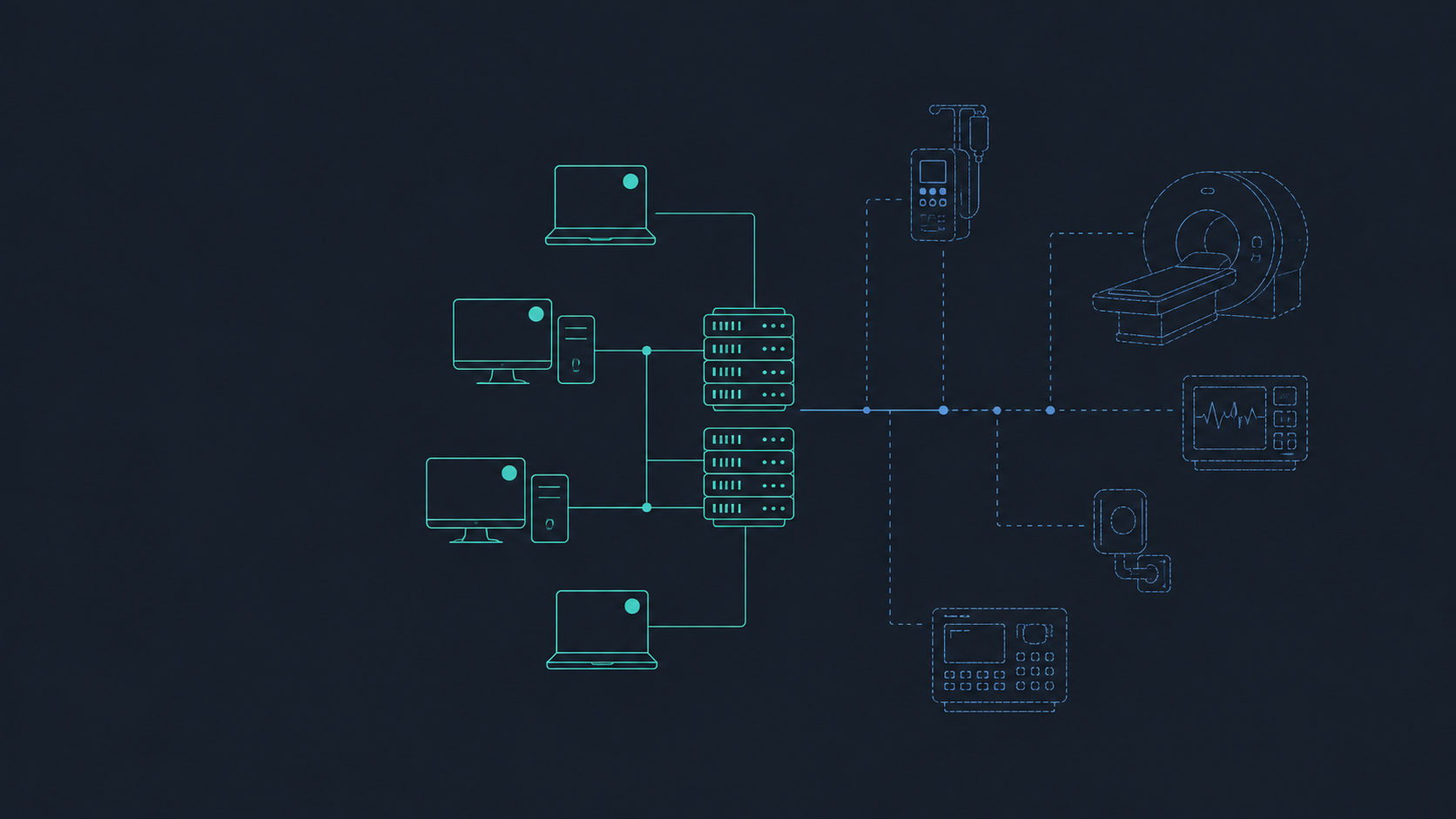
The unagentable blind spot is where too many hospital detection programs still break down. A modern healthcare environment is full of devices and traffic patterns that traditional endpoint-first controls either cannot cover or cannot inspect safely: legacy systems, medical devices, IoT, BYOD, shared clinical workstations, and east-west movement across the network.
HHS 405(d) found that 96% of hospitals report operating end-of-life operating systems or software, including medical devices, and notes that active scanning itself has disrupted medical devices in practice.
That means the places defenders most need visibility are often the places they can least afford to touch aggressively.
- 96% of hospitals report operating end-of-life systems or software, including medical devices
- Active scanning has disrupted medical devices in practice, so the usual discovery methods carry clinical risk
- HHS 405(d) reports that 71% of attacks are non-malware intrusions, with identity abuse playing a major role
- If your detection model starts and ends with what an agent can see, you are accepting blind spots in the highest-risk parts of the environment
- Network behavior is observable for every device, including the ones that can never run an agent
The problem is not theoretical. The same HHS 405(d) analysis reports that 71% of attacks are non-malware intrusions and highlights how quickly adversaries can move laterally after initial compromise, with identity abuse playing a major role. In other words, the threat path increasingly looks like legitimate credentials, living-off-the-land techniques, subtle behavior drift, and cross-network movement, not a neat malware signature on a well-managed endpoint.
If your detection model starts and ends with what an agent can see, you are implicitly accepting blind spots in some of the highest-risk parts of your environment.
A Structural Mismatch
For CISOs, this creates a structural mismatch. You are accountable for resilience across the whole care environment, but many of the systems that matter most to operations are difficult to patch, difficult to scan, or impossible to instrument with modern agents. That gap becomes especially dangerous in hospitals, where uptime requirements, biomedical constraints, and third-party dependencies make “just install more software” an unrealistic answer.
HHS 405(d) also found that only 49% of hospitals reported adequate supply-chain risk management, underscoring how much external connectivity and unmanaged exposure shapes hospital risk.
Why Network Behavior Matters
Personam approaches the problem from the metadata layer, learning what normal looks like across users, systems, peer groups, and communication patterns, without depending on payload inspection, static signatures, or endpoint deployment everywhere. That matters most in the places others miss: out-of-family behavior on a trusted account, low-and-slow exfiltration from a sanctioned workflow, command and control hidden inside a legitimate service, or a device suddenly behaving unlike its historical cohort.
The Evidence
The evidence is practical, not aspirational. In a U.S. healthcare provider ransomware exercise, Personam detected abnormal outbound behavior to Microsoft Teams infrastructure, surfaced the covert command and control activity in under 5 minutes, and supported full response in under 15 minutes, helping avoid an estimated $2.5M outage scenario.
In a global IP law firm, Personam identified low-and-slow insider data theft by correlating abnormal file-share access with out-of-character Dropbox use that other tools had not escalated. In a U.S. government insider-threat evaluation, Personam achieved 84% recall while narrowing review scope to roughly 3% of the monitored population.
What Each Approach Sees
- Nothing. No agent, no log, no telemetry
- Most medical devices cannot run EDR at all
- Shared credentials mask individual behavior entirely
- Every device profiled from its first network packet
- Behavioral shift in unagentable clinical devices
- 84% recall in a U.S. government insider-threat evaluation
The CISO Takeaway
You do not close the unagentable blind spot by asking unagentable systems to behave like managed laptops. You close it by watching the network behaviors that connect people, devices, credentials, and workflows across the whole environment. In healthcare, resilience depends on seeing what cannot be instrumented, what should not be disrupted, and what attackers increasingly exploit on purpose.
- HHS 405(d): Hospital Cyber Resiliency Initiative Landscape Analysis
- Personam case study: U.S. healthcare provider ransomware exercise
- Personam case study: Global IP law firm insider data theft
- Personam case study: U.S. government insider-threat evaluation
See what Personam finds in your network. Live demo, 30 minutes.
Schedule Demo