Modern threat actors don’t break in. They log in. When adversaries use valid credentials, native administrative tools like PowerShell or WMI, and approved network protocols, traditional security stacks are blind to the attack and so are security teams. The fundamental flaw in legacy network detection lies in its core architecture: rules require prior knowledge of an attack pattern, signatures miss novel tactics entirely, and heavy agents slow down host infrastructure without offering true cross-network visibility.
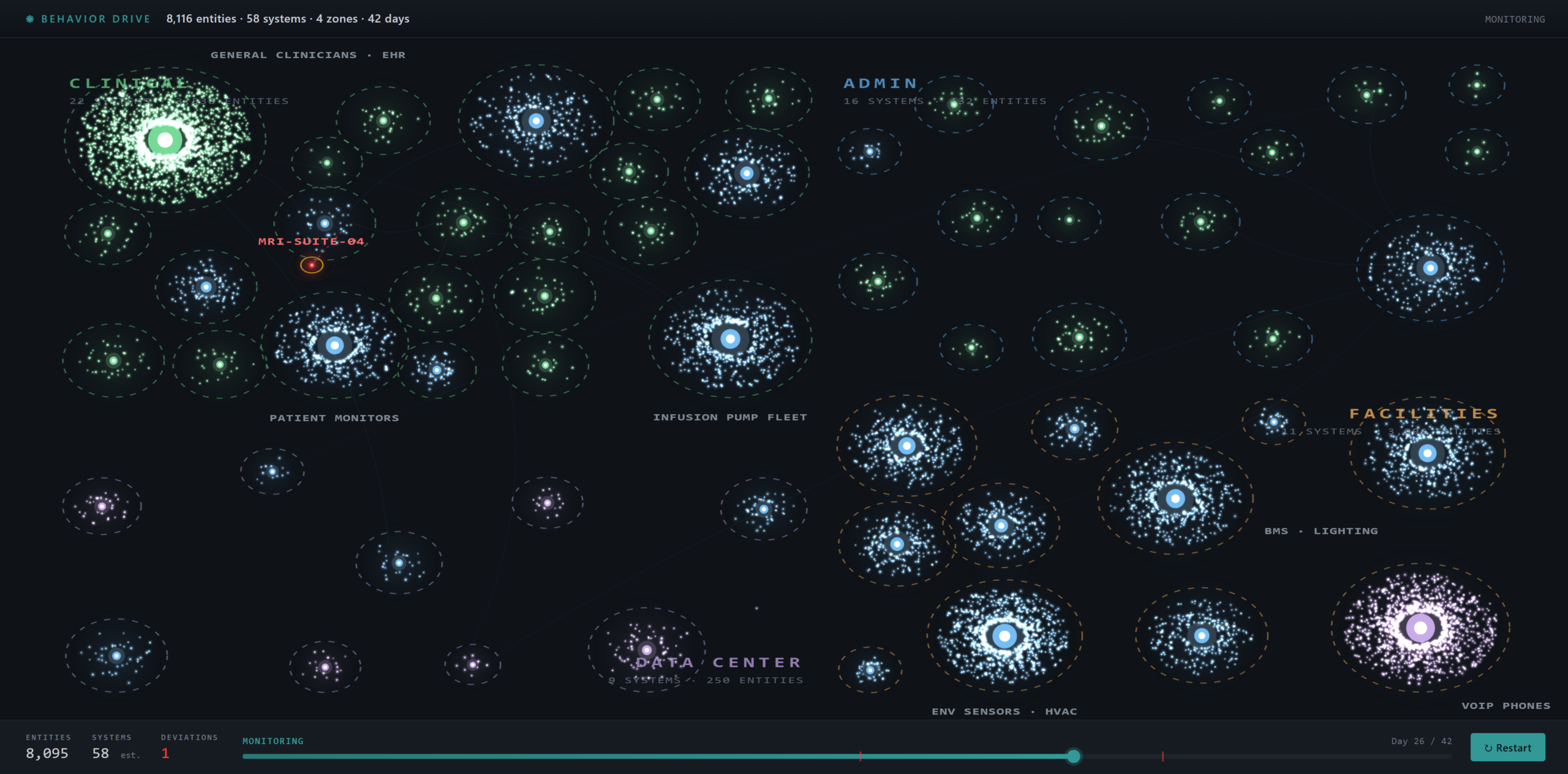
At Personam, we spent the last year completely rebuilding our platform and network threat detection UI to solve this operational deficit. Here is why an agentless, pure behavioral detection platform offers a far more effective defense for complex, modern environments.
The Blind Spot of Traditional Security Stacks
Most SOCs rely on a combination of Endpoint Detection and Response (EDR), Security Information and Event Management (SIEM), and traditional Network Traffic Analysis (NTA). While these tools are standard, they introduce significant operational friction:
- Rule Fatigue & Drift: Traditional SIEMs depend on pre-configured rules and static thresholds. As network environments change, rules require constant manual tuning, leading to false-positive fatigue or silent failures when tactics shift.
- Agent Coverage Gaps: EDR is critical, but it only protects assets where agents can be installed. Unmanaged devices, legacy servers, IoT hardware, operational technology (OT), and contractor laptops remain unmonitored blind spots.
- Identity Blindness: When an attacker uses compromised, legitimate credentials, standard perimeter and signature-based tools view the traffic as authorized, allowing lateral movement to proceed undetected.
1. True Behavioral Baselining vs. Rule Chasing
Rather than chasing indicators of compromise (IOCs) or configuring endless rules, Personam operates on a model of continuous, deterministic behavioral baselining.
- No Rules, Signatures, or Static Thresholds: Personam does not rely on known attack signatures or static rule sets that drift out of date.
- Entity-Level Baselines: The platform continuously maps what is normal across users, devices, applications, and network services.
- Detecting Abuse of Valid Credentials: By tracking subtle shifts in peer-group behavior, access timing, and interaction patterns, Personam spots adversaries using valid credentials and trusted tools before they accomplish their objectives.
2. Complete Agentless Network Visibility
Securing hybrid environments, merged networks, or newly acquired infrastructure requires immediate visibility without the delay of EDR rollouts.
- Zero Endpoint Friction: Personam deploys passively at the network layer, eliminating the need to install, configure, or maintain endpoint agents.
- 100% Asset Coverage: Monitor every entity connected to the network, whether managed, unmanaged, legacy, or cloud-hosted, from day one.
- Rapid Time-to-Value: Gain full visibility and automated baselining across complex environments in hours rather than months.
3. Streamlined Security Operations: The Rebuilt Interface
A powerful detection engine is only useful if analysts can digest and act on its output quickly. We introduced a completely redesigned user interface built specifically to streamline SOC triage workflows.
- High-Fidelity Signal, Minimal Noise: By filtering out routine environmental noise and focusing strictly on behavioral deviations outside normal parameters, Personam drastically reduces alert volume.
- Contextual Entity Relationships: The new UI immediately surfaces affected credentials, communication paths, and asset relationships, providing full context without requiring manual log correlation.
- Accelerated Investigation: Triage complex behavioral anomalies in minutes, allowing tier-1 analysts to understand the scope of lateral movement without sifting through millions of raw events.
Reclaiming the Advantage in Network Defense
Effective threat detection shouldn’t depend on endless manual tuning, agent deployment battles, or waiting for a signature update after a breach occurs. By shifting focus to native behavior, security teams can catch compromised credentials, insider threats, and stealthy lateral movement in real time.
Explore our redesigned platform UI and see how agentless behavioral AI changes the network defense equation at Personam.