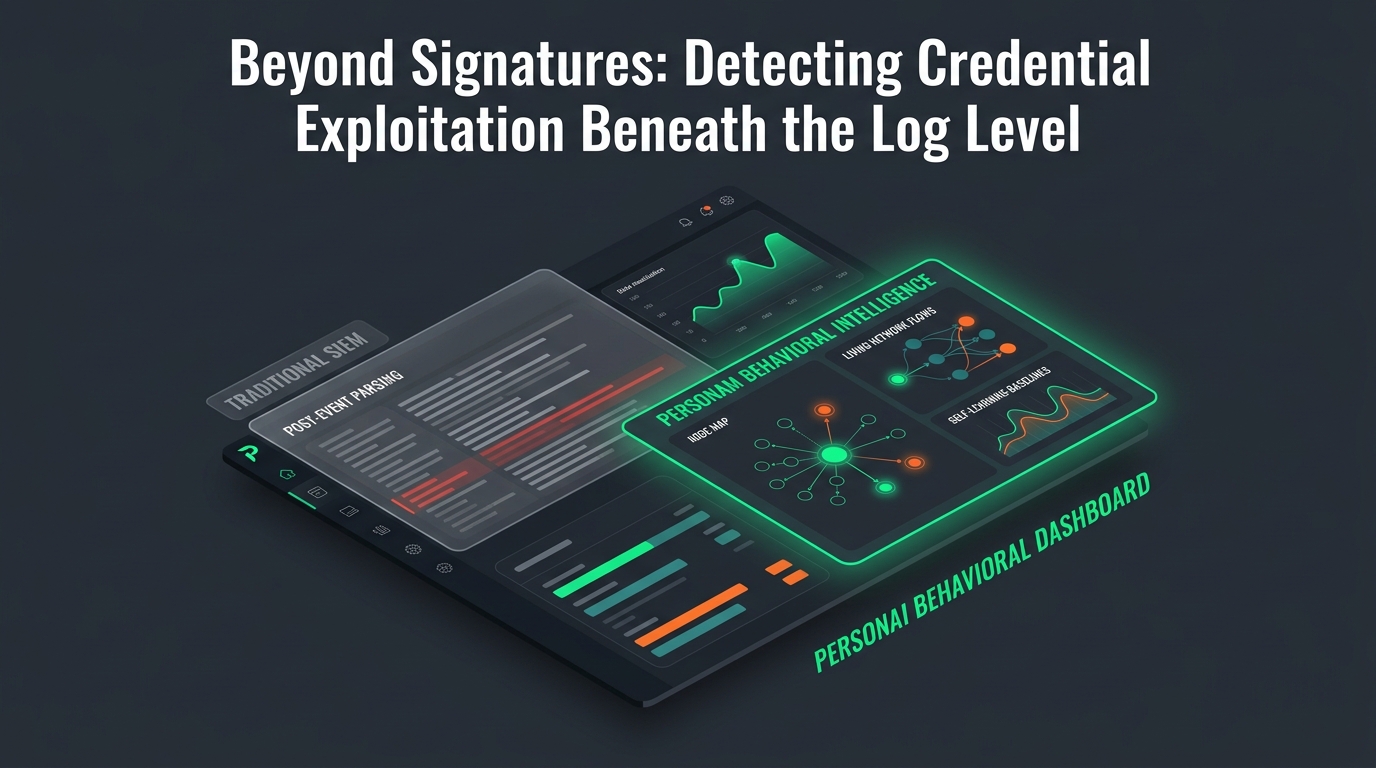
The Verification Paradox: Valid Credentials Pass Legacy Controls
Credentials do not guarantee intent. Enterprise security perimeters verify authentication through identity providers and multi-factor mechanisms. Once validated, the security stack treats subsequent session activity as benign. When an adversary acquires valid domain credentials through targeted phishing or session hijacking, traditional security components generate zero alerts.
Authentication establishes identity, not operational safety. Legacy firewalls and access management solutions validate the token presented at entry. They do not evaluate whether the subsequent operational behavior aligns with normal usage patterns.
Why Log Aggregation Fails Against Native Utilities
Logs record events, not context. Security Information and Event Management (SIEM) platforms rely on post-event log ingestion from endpoints and domain controllers. When an attacker executes Living Off the Land tactics, they leverage native administrative utilities like PowerShell or Windows Management Instrumentation (WMI).
The operating system records a standard process execution event. The security log reflects an authorized user initiating an approved system utility. Because both the credential and the tool are legitimate, static correlation rules fail to trigger. Post-event log parsing isolates individual events without evaluating mathematical deviations in entity behavior.
| Verification Dimension | Legacy Log Aggregation | Behavioral Intelligence Engine |
|---|---|---|
| Data Source | Post-event system logs and endpoint telemetry | Real-time network packet flow and protocol analysis |
| Detection Basis | Predefined signature matches and static thresholds | Continuous entity baselining and peer group analysis |
| Credential Abuse | Indistinguishable from legitimate administrative activity | Detected immediately via context and host behavior deviation |
| Operational Overhead | High agent maintenance and manual rule authoring | Zero-agent deployment with self-learning baselines |
Detecting Anomalous Context Through Peer Group Baselining
Behavior reveals the intruder. Detecting valid credential exploitation requires evaluating how an entity operates relative to its historical baseline and peer group. An administrative user within an enterprise subnet maintains specific, deterministic patterns of network communication.
Self-learning models eliminate manual rules. When an account accesses uncharacteristic host resources or initiates lateral communication outside its established peer group, the anomaly becomes visible. Personam functions as an agentless behavioral intelligence engine that inspects network traffic directly beneath the log level. It constructs continuous behavioral baselines for every IP address and entity across the environment. Deviations trigger alerts based on statistical mathematical divergence rather than static signature rules.
- Historical Entity Scope: Evaluates individual host interaction trends to identify subtle operational shifts.
- Peer Group Comparison: Benchmarks host activity against similar devices to detect unauthorized lateral movement.
Agentless Network Visibility Below the Operating System
Agents possess blind spots. Host-based monitoring software requires continuous maintenance, active operating system support, and endpoint agent health. Attackers frequently disable or unload host daemons during post-exploitation activities.
By analyzing raw network traffic natively, behavioral detection operates independently of endpoint health. Unmonitored devices and legacy infrastructure become instantly visible, eliminating critical coverage gaps across complex enterprise environments.
Request a Targeted Behavioral Risk Assessment
Evaluate your network exposure. Traditional security architectures leave a persistent visibility gap between initial authentication and post-incident log review. Stopping credential exploitation requires continuous, real-time behavioral analysis beneath the log level.
Identify active credential abuse and unmonitored lateral movement within your network. Request a targeted behavioral risk assessment to establish agentless behavioral baselines and secure your enterprise infrastructure.